Short-haul flights, usually defined as flights of 500 miles or less, are the wallowing pigs of carbon emissions from transportation. Pretty much the only worse alternative over that distance is 250 Hummer drivers going it solo. Unfortunately for most Americans, unlike the Europeans and Japanese, there is no congenial third way to travel - like, for instance, high-speed rail.
But the silver lining is that we Americans don't have to replace an aging steel wheel infrastructure like the rest of the developed world does. We can just build a new network for the most advanced surface transportation technology available: magnetic levitation rail, or "maglev" for short. Maglev has come a long way since it debuted for most average Americans at Disney World's Tomorrowland. There are several U.S. maglev projects in the advanced planning stages, almost all of them based on a German system called the Transrapid (www.transrapid.de).

Taking the Transrapid from Atlanta to Orlando would be just as fast as flying, if you include getting out to the airport and check-in time. And traveling via maglev would produce a fraction of the carbon dioxide emissions.
"Rail has gone as far as it can go," says Phyllis Wilkins, chairperson of the U.S. Maglev Coalition and executive director of Maglev Maryland. "If you want to take it to the next level, you have to go to maglev."
Wilkins has been working on the Baltimore-Washington Maglev Project (www.bwmaglev.com) for more than 15 years. The Transrapid-technology project would connect downtown Baltimore with the District of Columbia, stopping at Baltimore Washington International Airport on the way. Ideally, the BW Maglev line would eventually become part of an expanded route stretching from Boston to Charlotte, stimulating the creation of more efficient travel and housing patterns, making tourism more convenient and affordable, and chopping a few heads off the air and highway pollution hydra in our country's most densely-populated region.
That would be nice. Meanwhile the BW Maglev project has been waiting for the funding to complete its final environmental impact statement for three years, says Wilkins. In 2005 Congress appropriated $90 million for seven maglev pilot projects nationwide, but because of technical problems with the bill the money was never delivered. The bill was rewritten, and finally passed a few weeks ago. Wilkins says that once the funding arrives, the planning phase for the BW project can be wrapped up in about six months."Europe and Japan have a well-developed transportation infrastructure because they made the decision generations ago not to be dependent on foreign energy," she adds, "while Americans are only now realizing that we have to link transportation issues and environmental issues. All of us in transportation are becoming optimistic that we are finally being heard."

But ears start closing when officials hear the budget estimates associated with creating a national maglev infrastructure from the ground up. The Baltimore-Washington maglev project alone will require an investment of $3.7 billion in 2002 dollars - and that's for one of the shortest legs of the envisioned Northeast Corridor route.
The Transrapid has all but ground to a halt in Germany itself, where massive political pressure stirred up by the Green party in Munich recently killed plans to build a commercial line connecting the Bavarian capital's central railway station with the city's airport.
FEATURE
Don't Fly, Levitate: German Maglev as a Travel Alternative in the U.S.
Posted by
The Environmentalist
at
8/30/2008 01:47:00 AM
Labels: Barack Obama, Business, Carbon Emissions, Climate Change, Environment, Germany, High Speed Rail, IBS, Maglev, Magnetic Levitation Rail, Transportation, World News
SUBSCRIBE TO: POSTS (RSS)
FEATURE
Permafrost Threatened by Retreat of Arctic Sea Ice
Published on Reuters, Huffington Post, IBS, USAToday
The rate of climate warming over northern Alaska, Canada, and Russia could more than triple during extended episodes of rapid sea ice loss, according to a new study from the National Center for Atmospheric Research (NCAR) and the National Snow and Ice Data Center (NSIDC). The findings raise concerns about the thawing of permafrost, or permanently frozen soil, and the potential consequences for sensitive ecosystems, human infrastructure, and the release of additional greenhouse gases.
“The rapid loss of sea ice can trigger widespread changes that would be felt across the region,” said Andrew Slater, NSIDC research scientist and a co-author on the study, which was led by David Lawrence of NCAR. The findings will be published Friday in Geophysical Research Letters.
Last summer, Arctic sea ice extent shrank to a record low. From August to October last year, air temperatures over land in the western Arctic were also unusually warm, reaching more than 4 degrees Fahrenheit (2 degrees Celsius) above the 1978-2006 average. This led the researchers to question whether the unusually low sea ice extent and warm land temperatures were related.
Thawing permafrost may have a range of impacts, including buckled highways and destabilized houses, as well as changes to the delicate balance of life in the Arctic...
Posted by
The Environmentalist
at
7/02/2008 09:33:00 AM
Labels: Arctic, Climate Change, Environment, Global Warming, Huffington Post, IBS, NCAR, NSIDC, Permafrost, Reuters, Science, Sea Ice, USAToday
SUBSCRIBE TO: POSTS (RSS)
EPA Documents Bombshell: EPA Administrator's global warming warning withheld by White House
WASHINGTON (June 24, 2008) – The Environmental Protection Agency was on its way towards finding global warming emissions to be a danger to public welfare, and that these emissions should be regulated in vehicles and fuels, according to a review of subpoenaed global warming documents by the Select Committee on Energy Independence and Global Warming. The review of the documents follows a lengthy process of negotiation with the EPA and the White House, which started in January of 2008, and brings into serious question the administration’s u-turn on regulating global warming emissions. The documents are the draft regulatory recommendations from December 5 and December 14 of 2007, and were sent to the White House and to the National Highway Traffic Safety Administration (NHTSA) for approval before reports indicate all work was stopped on the recommendations. The White House is now in the process of completing an Advanced Notice of Proposed Rulemaking (ANPR), which would be a step backwards in what the Select Committee has found to be an already advanced process towards regulating global warming emissions. * EPA found that global warming risks include severe heat waves, sea level rise, reduced availability of water, increased wildfire and insect outbreaks, an increase in heavy precipitation events, an increase in regional ground-level ozone pollution, and changes in the range of vector-borne diseases. * When EPA used the EIA 2007 high gasoline price projections of $2.75 in 2017 to $3.20 in 2030 to calculate standards, it found that the car fleet could achieve a standard of 43.3 mpg by 2018 and light trucks could achieve a standard of 30.6 mpg by 2017.
Published on Reuters, Atlanta Journal-Constitution, Huffington Post, Chicago Sun-Times, Fox News, IBSThe House Select Committee on Energy Independence and Global Warming subpoenaed documents that reveal EPA Administrator, Stephen Johnson, had sent regulatory recommendations to the White House last year in which he unequivocally stated that global warming was occurring and that vehicle emissions were a danger to public welfare.
What makes this a bombshell: This is the same Stephen Johnson who denied California's request for higher emission standards waiver, stating that the lower Federal standard was enough -- the subject of an ongoing lawsuit between the EPA and at least 18 states plus environmental groups, resulting in a (different) subpoena for documents and eyewitness testimony by Henry Waxman (D-CA) to determine the extent of President Bush's intervention to lower those standards.
President Bush invoked executive privilege last week to avoid answering that subpoena.
“This administration has shown its contempt for Congress, its contempt for the rule of law, and this administration’s handling of the Massachusetts v. EPA decision has shown its contempt for science,” said [committee] Chairman [Edward] Markey (D-MA). “The president has a short amount of time to alter his legacy as running the most environmentally-unfriendly administration in history, and he can start by listening to his own climate scientists and take action on global warming.”
Among the findings in the documents: * EPA Administrator Stephen Johnson determined that man-made global warming is unequivocal, the evidence is both compelling and robust, and the administration must act to prevent harm rather than wait for harm to occur before acting.
* EPA proposed that regulations to reduce greenhouse gas emissions from motor vehicles be implemented in order to achieve the equivalent of a 35 mpg car and light truck fleet average by 2018 (with the car fleet averaging 38.4 mpg by 2018 and the truck fleet averaging 29.5 mpg by 2017).
Posted by
The Environmentalist
at
6/25/2008 11:22:00 PM
Labels: Atlanta Journal-Constitution, Chicago Sun-Times, Climate Change, Congress, Emission Standards, Environment, EPA, FoxNews, Global Warming, IBS, Politics, Reuters
SUBSCRIBE TO: POSTS (RSS)
FEATURE
NOAA makes it official: Extreme weather due to climate change
WASHINGTON - Droughts will get drier, storms will get stormier and floods will get deeper with a warming climate across North America, U.S. government experts said in a report billed as the first continental assessment of extreme events.
Events that have seemed relatively rare will become commonplace, said the latest report from the U.S. Climate Change Science Program, a joint effort of more than a dozen government agencies.
* Abnormally hot days and nights, along with heat waves, are very likely to become more common.
* Cold nights are very likely to become less common.
* Sea ice extent is expected to continue to decrease and may even disappear in the Arctic Ocean in summer in coming decades.
* Precipitation, on average, is likely to be less frequent but more intense.
* Droughts are likely to become more frequent and severe in some regions.
* Hurricanes will likely have increased precipitation and wind.
* The strongest cold-season storms in the Atlantic and Pacific are likely to produce stronger winds and higher extreme wave heights.
The report, issued by the Department of Commerce in accordance with Section 515 of the Treasury and General Government Appropriations Act for Fiscal Year 2001 was produced to be in compliance with that act in conjunction with NOAA.
For purposes of compliance with Section 515, this CCSP Synthesis and Assessment Product is an “interpreted product” as that term is used in NOAA guidelines and is classified as “highly influential.”
The U.S. Climate Change Science Program and the Subcommittee on Global Change Research today released a scientific assessment that provides the first comprehensive analysis of observed and projected changes in weather and climate extremes in North America and U.S. territories. The Intergovernmental Panel on Climate Change previously evaluated extreme weather and climate events on a global basis in this same context. However, there has not been a specific assessment across North America prior to this report.That's official. The extreme weather the U.S. has been experiencing is due to climate change and is expected to become more extreme in the future.
Among the major findings reported in this assessment are that droughts, heavy downpours, excessive heat, and intense hurricanes are likely to become more commonplace as humans continue to increase the atmospheric concentrations of heat-trapping greenhouse gases.
Posted by
The Environmentalist
at
6/23/2008 07:00:00 PM
Labels: Climate Change, Environment, FoxNews, Global Warming, Huffington Post, IBS, NOAA, Reuters, USAToday, Weather
SUBSCRIBE TO: POSTS (RSS)
FEATURE
McCain: Lock-step and (oil) barrel
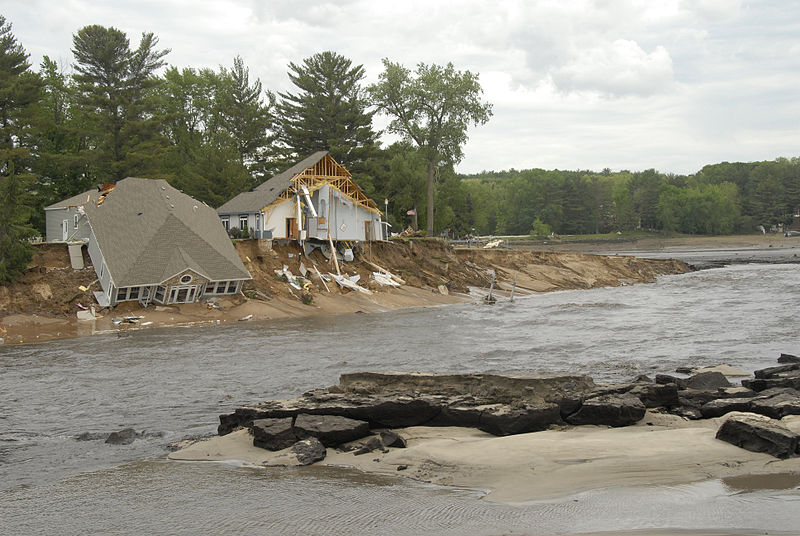
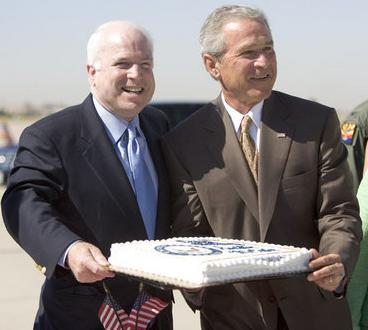
While Barack Obama was in Illinois shoveling sand in bags to hold back the Bush-neglected infrastructure crumbling around him -- resulting in a multi-state version of Katrina with both an oblivious Republican president and Republican presidential candidate -- John McCain just happened to be on his way to Texas to accept the whoops and cheers (and money) from oil industry insiders for his proclaimed flip-flop on offshore drilling as the answer to America's oil-supply woes.
Want something worse? Aside from the fact that he did it while Senator Obama was showing empathy to those impacted by an unstable climate and deteriorating infrastructure, it turns out that John McCain gave his oil pandering speech CONCURRENT to the release of his new ad-buy proclaiming his independence from the Bush Administration on global warming.
Hypocrisy, they name is McCain.
(Not that he's got support from every state with a governor who relies upon tourism to their oil-free beaches).
Not the first time we've seen this type of double-speak, this insult to our collective intelligence, this proof of the lock-step between all Republicans who have been bought and sold by Big Oil. Bush himself pulled this when he announced his support for the fight against global warming at the same time his administration was cutting NASA's climate monitoring satellite system.
Can't claim problems with the climate if ya can't see it, right?
Well, not exactly.
Oh, wait. THE ENVIRONMENTALIST called that one on March 20th (U.S. Floods a sign of things to come). Too late to rebuild every levee along the Mississippi, but the information had been available for some time -- for an administration that cared to look for it.
That very same Air Force One that Bush then used shortly thereafter to fly over the devastation?
President Bush knew not to fly over this latest hundred-year flood -- (he landed this time) -- as billions of acres of Heartland crops, the loss of which is destined to add to the world food crisis amid growing inflation, wash away along with people's homes and lives and dreams.
John McCain had not yet made his obligatory visit, though he does say he's coming. But not on the day Barack Obama was filling sandbags. McCain was too busy giving his milquetoast grin with those insecure eyes that speak to his lack of surety at the podium, while he offered the oil industry even more obscene profits than they've been able to speculate through the Enron loophole that his own campaign adviser, Phil Gramm, put through to accommodate Gramm's wife's position on the Enron board (before Gramm went off to lobby for a Swiss bank with energy investments)...
Posted by
The Environmentalist
at
6/19/2008 03:38:00 AM
Labels: Barack Obama, Climate Change, Enron, Environment, Floods, George W. Bush, Huffington Post, IBS, Jim Wilkinson, John McCain, Katrina, Lobbying, Michele Obama, Oil, Politics, Reuters
SUBSCRIBE TO: POSTS (RSS)
FEATURE
U.S. Floods a Sign of Things to Come
Reprint of article originally published on 3/21/08 forecasting current floods
Cross-posted on Reuters, USA Today, FoxNews, IBS, Atlanta Journal-Constitution
Major floods striking America’s heartland this week offer a preview of the spring seasonal outlook, according to NOAA’s National Weather Service. Several factors will contribute to above-average flood conditions, including record rainfall in some states and snow packs, which are melting and causing rivers and streams to crest over their banks. This week, more than 250 communities in a dozen states are experiencing flood conditions.“We expect rains and melting snow to bring more flooding this spring,” said Vickie Nadolski, deputy director of NOAA’s National Weather Service. “Americans should be on high alert to flood conditions in your communities. Arm yourselves with information about how to stay safe during a flood and do not attempt to drive on flooded roadways – remember to always turn around, don’t drown.”
The heavy precipitation may be related to the La Nina effect, as reported by the British Met(eorological) Office in this report. NOAA gives these reasons for the flood conditions:
- Above-normal flood potential is evident in much of the Mississippi River basin, the Ohio River basin, the lower Missouri River basin, Pennsylvania, New Jersey, most of New York, all of New England, and portions of the West, including Colorado and Idaho.
- Heavy winter snow combined with recent rain indicates parts of Wisconsin and Illinois should see minor to moderate flooding, with as much as a 20 to 30 percent chance of major flooding on some rivers in southern Wisconsin and northern Illinois.
Current snow depth in some areas of upstate New York and New England is more than a foot greater than usual for this time of the year, which increases flood potential in the Connecticut River Valley.
- Locations in the mountains of Colorado and Idaho have 150 to 200 percent of average water contained in snowpack leading to a higher than normal flood potential.
NOAA has also updated their Spring Drought Outlook with the following...
Posted by
The Environmentalist
at
6/16/2008 12:30:00 AM
Labels: Atlanta Journal-Constitution, Climate Change, Drought, Environment, Flood, FoxNews, IBS, NOAA, ODAY, Reuters, Science, USAToday, Weather
SUBSCRIBE TO: POSTS (RSS)
FEATURE
SF Bay Area Businesses to Pay C02 Fee
More than 2,500 businesses will be required to pay the proposed fees. About seven power plants and oil refineries would have to pay more than $50,000 a year, but the majority of businesses would pay less than $1, according to district estimates.The San Francisco Bay Area Air Quality Management District's Board of Directors has voted overwhelmingly (15-1) to impose a carbon fee on Bay Area businesses. The new rules will cover the nine Bay Area counties and will include refineries and power plants:
The Bay Area fees are expected to generate $1.1 million in the first year to help pay for programs to measure the region's emissions and develop ways to reduce them.
Posted by
The Environmentalist
at
5/22/2008 07:19:00 PM
Labels: Business, C02, Climate Change, Environment, Gavin Newsom, Global Warming, IBS, Reuters
SUBSCRIBE TO: POSTS (RSS)
Toxic alert: Bottles, Cans and BPA
As reported in this June 2007 article , the EU banned of the use of the chemical, bisphenol A (BPA) (along with 3,000 other chemicals) last year, after they identified BPA as an endocrine disrupter. Now, nearly one year later, a report from the National Institute of Health's Toxicology Unit has agreed with their conclusion:
A chemical called bisphenol A, which is in hard, clear polycarbonate plastics like those used to make many baby bottles, certain reusable water bottles, and even containers for canned foods, may pose health risks. Specifically, the federal government's National Toxicology Program expressed concern that BPA exposure could cause neural and behavioral abnormalities in fetuses, infants, and children.
Since that announcement, Canada has proposed a BPA ban, and retailers Toys "R" Us and Wal-Mart both said they plan to stop selling BPA-containing baby bottles, according to USA Today. Playtex also said it would stop using BPA in its products, and Nalgene, a maker of durable plastic water bottles, said it intends to do the same.An endocrine disruptor is a substance that alters the function of the endocrine system and consequently can cause adverse health effects to an organism and/or its progeny. Endocrine disrupters interfere with the endocrine system in (at least) three ways...
[1] [2]
Posted by
The Environmentalist
at
5/22/2008 07:44:00 AM
Labels: BPA, Chicago Sun-Times, Environment, EU, Health, IBS, Reuters, Science, Toxin
SUBSCRIBE TO: POSTS (RSS)
Texas oilman planning huge wind farm
T. Boone Pickens, Jr., the Texas billionaire oilman, is planning to put billions into a 4,000 megawatt wind farm in Texas with the capacity to power 1.3 million homes.
Pickens said he will be purchasing GE Turbines to install in central Texas from 2010 to 2015 on a royalty share basis with landowners in order to obtain access to wind. "The Department of Energy came out with a study in April of '07 that said we could generate 20 percent of our electricity from wind. And the wind power is -- you know, it's clean, it's renewable. It's -- you know, it's everything you want. And it's a stable supply of energy.
It will be located in [the] central part of the United States, which will be the best from a safety standpoint to be located. You have a wind corridor that goes from Pampa, Texas, to the Canadian border. And it has -- the wind, it's unbelievable that we have not done more with wind. Look at Germany and Spain. They have developed their wind way beyond what we have, and they don't have as much wind as we do. It's not unlike the French have done with their nuclear. They're 80 percent power generated off of nuclear, we're 20 percent.
A turbine will generate somewhere around 20,000 [dollars] a year in royalty income [some of which to benefit those who put them on their land]. And on a 640-acre tract, you can put five to 10 of these on the tract. And you don't have to have them if you don't want them."This is an important offering from Pickens, the chairman of the BP Capital Management hedge fund, known as the "Oracle of Oil" with a personal net worth (in 2007) of 3 billion dollars...
Posted by
The Environmentalist
at
5/22/2008 07:09:00 AM
Labels: Atlanta Journal-Constitution, Business, Climate Change, Energy, Environment, FoxNews, Global Warming, Houston Chronicle, IBS, Oil, Reuters, T. Boone Pickens Jr., Wind, Wind Farming
SUBSCRIBE TO: POSTS (RSS)
FEATURE
Bush Speech Shakes Up Paris Climate Talks
At the U.S. sponsored climate meeting in Paris this week (third in a series), everyone was abuzz with the news that President Bush had chosen to offer his approach to greenhouse gases as the Paris talks opened:
The Bush speech was aimed largely at a domestic audience. Bush's aides said it was aimed at heading off a "train wreck" of varying legislation in the U.S. Congress.
Timed for Paris but not about Paris, a meeting that is the result of the U.S. inability to sort climate change at the Bali meeting in December, which led to the follow-up meetings taking place parallel to the UN meetings on the replacement for the Kyoto Accord.
Confused yet?
Confusing and frustrating because not enough is being done and now President Bush, in his Rose Garden declaration, insists he has a better idea of how to lower greenhouse gases before it's too late, when the consensus is that the policies he's proposed are too little too late:The meetings are part of a U.S.-sponsored series of negotiations on global warming. They involve representatives from the countries that produce 80 percent of the world's greenhouse gas emissions, blamed for heating the planet — including the United States, the 27-nation European Union, China and India.
Two weeks ago, I flew to London and then on to Scotland to find it covered in snow -- all of the UK. Which, of course, has been fodder for deniers who don't understand that climate change means climate instability and the cooler La Nina year we're experiencing will not necessarily be kind enough to repeat itself in 2009...
Schalkwyk said Bush's speech "takes us backward," because it did not call for mandatory emissions cuts. Such cuts are central to U.N. negotiations on a follow-up plan to the Kyoto Protocol. Delegates from the European Commission and the EU presidency found Bush's strategy "disappointing," said the chief U.N. climate change official, Yvo de Boer.
Posted by
stormchaser
at
4/18/2008 07:43:00 AM
Labels: Atlanta Journal-Constitution, Climate Change, Environment, FoxNews, George W. Bush, Global Warming, IBS, Kyoto Protocol, Reuters, Stormchaser, United Nations
SUBSCRIBE TO: POSTS (RSS)
FEATURE
Interior Secretary no-show at Senate Polar Bear Hearing
The Bush Administration's Interior Secretary, Dirk Kempthorne, was a no-show at last Wednesday's Senate Environmental and Public Works Committee hearing, chaired by Barbara Boxer, on the listing of the polar bear as an endangered species.
"This listing is months overdue, in violation of the Endangered Species Act," the California Democrat said at the hearing of the Senate Environmental and Public Works Committee.
The hearing did receive testimony from witnesses on climate change projections, emissions, and the potential for oil spills to further impact the polar bear's ability to survive amidst declining sea ice due to warming.
The deadline for a decision was Jan. 9. Conservation groups petitioned to list polar bears as threatened more than three years ago because their habitat, sea ice, is shrinking from global warming.
In a letter to Boxer, Kempthorne said he "respectfully" declined her invitation to appear at the hearing, since he is a named defendant in a lawsuit over the polar bear listing filed by an environmental group.
Critics to listing the polar bear as an endangered species include the Interior Department, after its subsidiary, the Fish and Wildlife Service, requested it be added on January 7, 2008. The Interior Department raised the concern that the Fish and Wildlife Service does not have the resources to handle the duties that would arise with the change in designation. Other critics, according to this MSNBC article, have raised a more direct concern that listing the polar bear would limit oil and gas exploration in the Arctic. "It's a professional wildlife agency, not an air-regulating agency," said William Horn, an attorney and former assistant Interior secretary for Fish and Wildlife in the Reagan administration.
To which, Senator Boxer replied: "...sadly, despite the peer-reviewed scientific evidence; despite the opinions of scientists in our own government; despite the fact that we have a strong, successful law to protect imperiled species — the Endangered Species Act — the Bush Administration continues to break the law by failing to make a final decision to list the polar bear."
Posted by
The Environmentalist
at
4/08/2008 01:11:00 AM
Labels: Animals, Barbara Boxer, Climate Change, Dirk Kempthorne, Endangered Species, Environment, Fish and Wildlife Service, Global Warming, IBS, Polar Bear, Politics, Reuters, Senate, Wildlife
SUBSCRIBE TO: POSTS (RSS)
Carnegie Study: Climate Requires Near-zero Emissions
The scientists investigated how much climate changes as a result of each individual emission of carbon dioxide, and found that each increment of emission leads to another increment of warming. With emissions set to zero in the simulations, the level of carbon dioxide in the atmosphere slowly fell as carbon “sinks” such as the oceans and land vegetation absorbed the gas. Surprisingly, however, the model predicted that global temperatures would remain high for at least 500 years after carbon dioxide emissions ceased.Scientists at the Carnegie Institution have just completed a study that has concluded the only way to stabilize the climate is to reduce carbon emissions to a near-zero level:
In the study, to be published in Geophysical Research Letters, climate scientists Ken Caldeira and Damon Matthews used an Earth system model at the Carnegie Institution’s Department of Global Ecology to simulate the response of the Earth’s climate to different levels of carbon dioxide emission over the next 500 years. ~snip~
In our earlier article, Everything but the Oceans' Sink, we explored the connection between global warming and the inability of the Southern Ocean to absorb C02. Caldeira and Matthews' study further points to the connection between carbon sinks and the impact on climate stability. Matthews and Caldeira found that to prevent the Earth from heating further, carbon dioxide emissions would, effectively, need to be eliminated...
Posted by
The Environmentalist
at
4/01/2008 10:46:00 PM
Labels: Climate Change, Environment, FoxNews, Global Warming, IBS, Reuters, Science, Stormchaser, USAToday
SUBSCRIBE TO: POSTS (RSS)
Congress grills Big Oil on prices
Representative Markey's take on the profits:
“On April Fool’s Day, the biggest joke of all is being played on American families by Big Oil, while using every trick in the book to keep billions in federal tax subsidies even as they rake in record profits,” said Rep. Edward Markey, D-Mass. [video]
As reported in this article, Congress to drill for answers on oil prices, both the House and the Senate are holding hearings this week regarding the record profits by oil companies. The House hearings are focusing on the actual profits by the big five oil companies; Exxon Mobile, Chevron, ConocoPhillips, BP and Royal Dutch Shell.
The Senate investigation will be on the impact of investors on rising prices.
Lawmakers were looking for answers to the soaring fuel costs a day after the Energy Department said the national average price of gasoline reached a record $3.29 cents a gallon and global oil prices remained above $100 a barrel although supplies of both gasoline and oil seemed to be adequate.Oil recently reached a high of $111 a barrel.
~snip~
In November, 2005, Hofmeister and the top executives of the same companies represented Tuesday, sat in a Senate hearing room to explain high prices and their h&uge profits. The prices are of concern, Hofmeister said at the time, adding a note of optimism: "Our industry is extremely cyclical and what goes up almost always comes down," he told the skeptical senators on a day when oil cost $60 a barrel.
The increase in the price of gasoline is hitting all sectors of the American economy. Truckers, dependent upon high diesel prices, have been particularly hard hit, leading to an increase in the inflation index for the products they carry. This ranges from milk to hardware to the price increase announced by Delta Airlines today due to high fuel costs...
Posted by
The Environmentalist
at
4/01/2008 11:33:00 AM
Labels: Business, Congress, Edward Markey, Environment, FoxNews, IBS, Oil, Politics, Reuters, Senate, USAToday
SUBSCRIBE TO: POSTS (RSS)
FEATURE
Congress to drill for answers on oil prices
NEW YORK (CNNMoney.com) -- Under the backdrop of record gas prices and record profits, Congress is set to grill executives Tuesday from the world's five biggest publicly traded oil companies.The hearings are set to open Tuesday before the House Select Committee on Energy Independence and Global Warming chaired by Congressman Edward Markey (D-MA):
Lawmakers are expected to focus their questions on why the cash-rich industry needs $18 billion in tax breaks over ten years with some in Congress looking to take them away and use them to subsidize renewable energy projects.
On Tuesday, April 1, 2008, Chairman Edward J. Markey (D-Mass.) will bring top-level executives from the five largest oil companies to discuss the current state of oil and gas prices, oil company profits, and the need for clean, renewable fuels to ease demand for oil and cut global warming pollution. The Select Committee will hear from the number two officers worldwide for the three United States-based oil companies and the presidents of U.S. operations for the foreign companies.
* Mr. J. Stephen Simon, Senior Vice President, Exxon Mobil Corp.
* Mr. John Hofmeister, President, Shell Oil Company
* Mr. Robert A. Malone, Chairman and President, BP America, Inc.
* Mr. Peter Robertson, Vice Chairman, Chevron
* Mr. John Lowe, Executive Vice President, ConocoPhillips
The hearing will start at 12 pm EST, Tuesday, April 1, 2008, at 210 Cannon House Office Building, Washington, DC and on the web at globalwarming.house.gov. On Thursday, the Senate committee on Energy and Natural Resources will hear testimony Thursday regarding the role investment money has on oil prices...
Posted by
The Environmentalist
at
3/31/2008 04:34:00 PM
Labels: Business, Congress, Environment, FoxNews, IBS, Oil, Politics, Reuters, Senate
SUBSCRIBE TO: POSTS (RSS)
FEATURE
Lights at Night Linked to Breast Cancer
Women who live in neighborhoods with large amounts of nighttime illumination are more likely to get breast cancer than those who live in areas where nocturnal darkness prevails, according to an unusual study that overlaid satellite images of Earth onto cancer registries.
"By no means are we saying that light at night is the only or the major risk factor for breast cancer," said Itai Kloog, of the University of Haifa, who led the new work. "But we found a clear and strong correlation that should be taken into consideration."
The mechanism of such a link, if real, remains mysterious, but many scientists suspect that melatonin is key.
A tumor suppressing hormone long known to be impacted by the nighttime illumination, melatonin requires darkness for its synthesis and release:
Melatonin is a neurohormone produced in the brain by the pineal gland, from the amino acid tryptophan. The synthesis and release of melatonin are stimulated by darkness and suppressed by light, suggesting the involvement of melatonin in circadian rhythm and regulation of diverse body functions.
(The study has not recommended melatonin supplementation. Not enough is known about the melatonin connection. Further studies will be required).
Posted by
The Environmentalist
at
2/21/2008 12:43:00 AM
Labels: Cancer, Environment, Health, IBS, Living, Melatonin, NASA, Oxford Press, Science, WHO
SUBSCRIBE TO: POSTS (RSS)