Loading...
HOME
POLITICS
CLIMATE
BUSINESS
SCIENCE
WORLD
HISTORY
LIFESTYLE
EDITORIAL
RESOURCES
CONTACT
Showing posts with label NOAA. Show all posts

FEATURE

Hurricane Earl Intensifies into Massive Storm (Video)


AnswerTips-Enabled

NASA has provided footage of Hurricane Earl as a Category 4 storm in the mid-Atlantic as it approaches the East Coast of the United States. The Hurricane is so large that, even if it does not make landfall, it is dangerous because of its winds, high waves, surges and rip currents.

NASA has provided footage of Hurricane Earl from the Space Station. The Hurricane has grown so large that it is expected to do some damage as far north as New England even without landfall. The governors of North Carolina, Maryland and Virginia have declared a state of emergency. President Obama has declared a national state of emergency for North Carolina. Mandatory evacuations are underway. Other states are expected to follow suit once there is more certainty of its path. Continued...


FEATURE

NOAA: Past Decade Warmest on Record According to Scientists in 48 Countries


AnswerTips-Enabled

The 2009 State of the Climate report released today draws on data for 10 key climate indicators that all point to the same finding: the scientific evidence that our world is warming is unmistakable. More than 300 scientists from 160 research groups in 48 countries contributed to the report, which confirms that the past decade was the warmest on record and that the Earth has been growing warmer over the last 50 years.

Based on comprehensive data from multiple sources, the report defines 10 measurable planet-wide features used to gauge global temperature changes. The relative movement of each of these indicators proves consistent with a warming world. Seven indicators are rising: air temperature over land, sea-surface temperature, air temperature over oceans, sea level, ocean heat, humidity and tropospheric temperature in the “active-weather” layer of the atmosphere closest to the Earth’s surface. Three indicators are declining: Arctic sea ice, glaciers and spring snow cover in the Northern hemisphere.

“For the first time, and in a single compelling comparison, the analysis brings together multiple observational records from the top of the atmosphere to the depths of the ocean,” said Jane Lubchenco, Ph.D., under secretary of commerce for oceans and atmosphere and NOAA administrator. “The records come from many institutions worldwide. They use data collected from diverse sources, including satellites, weather balloons, weather stations, ships, buoys and field surveys. These independently produced lines of evidence all point to the same conclusion: our planet is warming,”  Continued...


[ [1] 2 ] read more...

FEATURE

The Planet Has a Fever


AnswerTips-Enabled

Have you felt it? The sweltering summer that has strained the grid? The floods and tornadoes and the hail? The increased humidity where it was a dry heat? The dry heat where it was moist?

The planet has a fever. That's not supposition. The National Climactic Data Center of the National Oceanic and Atmospheric Administration (NOAA) has recorded year-to-date combined global and and surface temperatures that are the warmest on record.

• The combined global land and ocean surface temperature for April-June 2010 was 1.26°F (0.70°C) above the 20th century average—the warmest April-June period on record.

• For the year-to-date, the global combined land and ocean surface temperature of 57.5°F (14.2°C) was the warmest January-June period. This value is 1.22°F (0.68°C) above the 20th century average.

• June 2010 was the fourth consecutive warmest month on record (March, April, and May 2010 were also the warmest on record). This was the 304th consecutive month with a global temperature above the 20th century average. The last month with below-average temperature was February 1985.

• It was the warmest June and April–June on record for the Northern Hemisphere as a whole and all land areas of the Northern Hemisphere.

• Arctic sea ice continued its annual decline, typically reaching a September minimum. Similar to May 2010, the Arctic sea ice continued to decline at a record rapid rate—the fastest measured for June (more than 50 percent greater than average).  Continued...

[ [1] 2 ] read more...


FEATURE

NOAA Expects Busy Atlantic Hurricane Season


AnswerTips-Enabled

An “active to extremely active” hurricane season is expected for the Atlantic Basin this year according to the seasonal outlook issued today by NOAA’s Climate Prediction Center – a division of the National Weather Service. As with every hurricane season, this outlook underscores the importance of having a hurricane preparedness plan in place.

Across the entire Atlantic Basin for the six-month season, which begins June 1, NOAA is projecting a 70 percent probability of the following ranges:

• 14 to 23 Named Storms (top winds of 39 mph or higher), including:
• 8 to 14 Hurricanes (top winds of 74 mph or higher), of which:
• 3 to 7 could be Major Hurricanes (Category 3, 4 or 5; winds of at least 111 mph)

“If this outlook holds true, this season could be one of the more active on record,” said Jane Lubchenco, Ph.D., under secretary of commerce for oceans and atmosphere and NOAA administrator. “The greater likelihood of storms brings an increased risk of a landfall. In short, we urge everyone to be prepared.”  Continued...


FEATURE

Why Obama's pick for NOAA Matters: Jane Lubchenco


AnswerTips-Enabled


President-elect Obama has shown that he is serious about picking the right person to lead the National Oceanic and Atmospheric Administration (NOAA) with his choice of Jane Lubchenco, an expert in overfishing and climate change who would have firsthand knowledge of the collapse of fishing along the Oregon coast.

As reported in The Environmentalist last April, Salmon Fishing Canceled off the Oregon and California Coasts, the Chinook salmon run in the Sacramento River has collapsed:
Scientists are studying the causes of the Sacramento River chinook collapse, with possible factors ranging from ocean conditions and habitat destruction to dam operations and agricultural pollution.
Fisherman normally loathe to shut operations supported the cancellation of the season in the desperate hope they would see a return of salmon to the river in 2009.

"For the entire West Coast, this is the worst in history," Don McIsaac, exec
utive director of the Pacific Fishery Management Council, said before several close votes led to the fisheries plan for 2008.

As the Pacific Fishery Management Council relies upon NOAA to approve such plans, it becomes imperative that NOAA's mission is not impeded by politics or greed as was reported in this related article
from the Washington Post that explored Vice President Dick Cheney's possible involvement with the earlier Klamath Falls, Oregon salmon collapse.

In Oregon, a battleground state that the Bush-Cheney ticket had lost by less than half of 1 percent, drought-stricken farmers and ranchers were about to be cut off from the irrigation water that kept their cropland and pastures green. Federal biologists said the Endangered Species Act left the government no choice: The survival of two imperiled species of fish was at stake.

Law and science seemed to be on the side of the fish. Then the vice president stepped in. First Cheney looked for a way around the law, aides said. Next he set in motion a process to challenge the science protecting the fish, according to a former Oregon congressman who lobbied for the farmers.

Because of Cheney's intervention, the government reversed itself and let the water flow in time to save the 2002 growing season, declaring that there was no threat to the fish. What followed was the largest fish kill the West had ever seen, with tens of thousands of salmon rotting on the banks of the Klamath River.

Continued...

FEATURE

Palin Loses Attempt to Block Protection of Alaska's Whales


AnswerTips-Enabled


When the Center for Biological Diversity's 2006 request to have Alaska's beluga whales put on the endangered list came up for consideration last April, Alaska Gov. Sarah Palin questioned the scientific evidence that the population was declining and lobbied for a six month delay to count the whales.

The answer is in. According to the National Marine Fisheries Service, run by the National Oceanic and Atmospheric Administration (NOAA), the whales, whose population declined by 50& in the 1990's, have shown no recovery despite the protections already in place. As such, the federal government determined on Friday that the "beluga whales species native to Anchorage, Alaska, is endangered and will require protection to survive."
"NOAA scientists estimated the Cook Inlet beluga population at 375 for both 2007 and 2008," NOAA stated. "Estimates have varied from a high of 653 belugas in 1994 to a low of 278 belugas in 2005."

The listing has the potential to affect major Alaska projects including an expansion of the Port of Anchorage, additional offshore oil and gas drilling, a proposed $600 million bridge connecting Anchorage to Palin's hometown of Wasilla and a massive coal mine 45 miles south of Anchorage.

Palin had opposed the endangered listing -- as well as one decreed for polar bears due to melting summer sea ice -- in part by questioning the science and saying the listings would hinder oil and natural gas drilling.

NOAA's decision to list whales means any federal agency that funds, authorizes, or carries out new projects or activities in the area must first consult with NOAA to determine the impact on Anchorage's beluga whales.

Friday's listing follows an accusation by the Center for Biological Diversity of stalling by the Bush Administration, citing federal law that required the identification of a critical habitat listing by last April.

NOAA has stated they will determine -- within one year -- the changes needed in the whales' habitat for their survival. In the meantime, the placement of the beluga whales on the endangered list provides for their protection according to NOAA scientists' assessment of the species' needs which supersedes Governor Palin's and the Bush Interior Department's interpretation of science... Continued...

FEATURE

NOAA makes it official: Extreme weather due to climate change


AnswerTips-Enabled


In a report issued by the U.S. Climate Change Science Program, a joint effort of more than a dozen government agencies which includes the National Oceanic and Atmospheric Administration (NOAA), the conclusion is that the extreme weather we've been experiencing will become both more extreme and is due to climate change.
WASHINGTON - Droughts will get drier, storms will get stormier and floods will get deeper with a warming climate across North America, U.S. government experts said in a report billed as the first continental assessment of extreme events.

Events that have seemed relatively rare will become commonplace, said the latest report from the U.S. Climate Change Science Program, a joint effort of more than a dozen government agencies.
This report has raised questions by those who point to this year's cooler temperatures in many parts of the world. That issue was addressed by the British Met Office's 2008 temperature prediction which cited an increased 2008
La Niña event; a cooling of a Pacific current - a periodic anomaly that was covered in this report: What's with the Weather? The La Niña-Tornado Connection.

Specific project
ions from the Climate Sciences report include:

* Abnormally hot d
ays and nights, along with heat waves, are very likely to become more common.
* Cold nights are very likely to bec
ome less common.
* Sea ice extent is expected to continue to decrease and may even disappear in the Arctic Ocean in summer in coming decades.

* Precipitatio
n, on average, is likely to be less frequent but more intense.
* Droughts are likely to become more frequent and severe in some regions.
* Hurricanes will likely have increased precipitation and wind.

* The strongest
cold-season storms in the Atlantic and Pacific are likely to produce stronger winds and higher extreme wave heights... Continued...

FEATURE

NOAA makes it official: Extreme weather due to climate change


AnswerTips-Enabled

Published on Reuters, The Huffington Post, IBS, Fox News, USA Today


In a report issued by the U.S. Climate Change Science Program, a joint effort of more than a dozen government agencies -- including the National Oceanic and Atmospheric Administration -- the conclusion is that the extreme weather we've been experiencing will become more extreme and is due to climate change.
WASHINGTON - Droughts will get drier, storms will get stormier and floods will get deeper with a warming climate across North America, U.S. government experts said in a report billed as the first continental assessment of extreme events.

Events that have seemed relatively rare will become commonplace, said the latest report from the U.S. Climate Change Science Program, a joint effort of more than a dozen government agencies.
Specific future projections include:

* Abnormally hot days and nights, along with heat waves, are very likely to become more common.
* Cold nights are very likely to bec
ome less common.
* Sea ice extent is expected to continue to decrease and may even disappear in the Arctic Ocean in summer in coming decades.

* Precipitatio
n, on average, is likely to be less frequent but more intense.
* Droughts are likely to become more frequent and severe in some regions.
* Hurricanes will likely have increased precipitation and wind.

* The strongest
cold-season storms in the Atlantic and Pacific are likely to produce stronger winds and higher extreme wave heights.

The report, issued by the Department of Commerce in accordance with Section 515 of the Treasury and General Government Appropriations Act for Fiscal Year 2001 was produced to be in compliance with that act in conjunction with NOAA.
For purposes of compliance with Section 515, this CCSP Synthesis and Assessment Product is an “interpreted product” as that term is used in NOAA guidelines and is classified as “highly influential.”
Which means the report cannot require regulatory action, though it can (and should) influence it. From the NOAA press release:
The U.S. Climate Change Science Program and the Subcommittee on Global Change Research today released a scientific assessment that provides the first comprehensive analysis of observed and projected changes in weather and climate extremes in North America and U.S. territories. The Intergovernmental Panel on Climate Change previously evaluated extreme weather and climate events on a global basis in this same context. However, there has not been a specific assessment across North America prior to this report.

Among the major findings reported in this assessment are that droughts, heavy downpours, excessive heat, and intense hurricanes are likely to become more commonplace as humans continue to increase the atmospheric concentrations of heat-trapping greenhouse gases.
That's official. The extreme weather the U.S. has been experiencing is due to climate change and is expected to become more extreme in the future.

[1] [2]

U.S. Floods a Sign of Things to Come


AnswerTips-Enabled


Reprint of article originally published on 3/21/08 forecasting current floods

Cross-posted on Reuters, USA Today, FoxNews, IBS, Atlanta Journal-Constitution

The National Oceanic and Atmospheric Administration (NOAA) has issued a report that states the flooding we're seeing in the U.S. heartland is a sign of things to come.
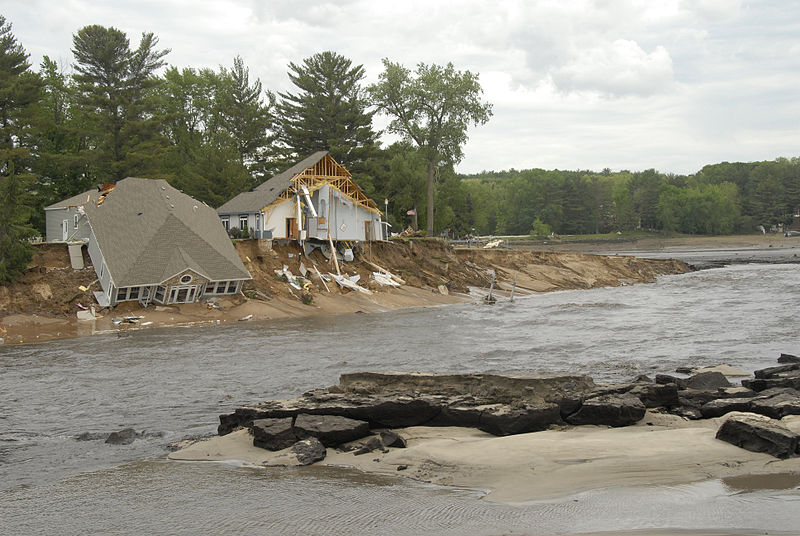
Major floods striking America’s heartland this week offer a preview of the spring seasonal outlook, according to NOAA’s National Weather Service. Several factors will contribute to above-average flood conditions, including record rainfall in some states and snow packs, which are melting and causing rivers and streams to crest over their banks. This week, more than 250 communities in a dozen states are experiencing flood conditions.
“We expect rains and melting snow to bring more flooding this spring,” said Vickie Nadolski, deputy director of NOAA’s National Weather Service. “Americans should be on high alert to flood conditions in your communities. Arm yourselves with information about how to stay safe during a flood and do not attempt to drive on flooded roadways – remember to always turn around, don’t drown.”

The heavy precipitation may be related to the La Nina effect, as reported by the British
Met(eorological) Office in this report. NOAA gives these reasons for the flood conditions:
  1. Above-normal flood potential is evident in much of the Mississippi River basin, the Ohio River basin, the lower Missouri River basin, Pennsylvania, New Jersey, most of New York, all of New England, and portions of the West, including Colorado and Idaho.

  2. Heavy winter snow combined with recent rain indicates parts of Wisconsin and Illinois should see minor to moderate flooding, with as much as a 20 to 30 percent chance of major flooding on some rivers in southern Wisconsin and northern Illinois.

  3. Current snow depth in some areas of upstate New York and New England is more than a foot greater than usual for this time of the year, which increases flood potential in the Connecticut River Valley.

  4. Locations in the mountains of Colorado and Idaho have 150 to 200 percent of average water contained in snowpack leading to a higher than normal flood potential.

NOAA has also updated their Spring Drought Outlook with the following...

FEATURE

What's with the Weather? The La Niña-Tornado Connection


AnswerTips-Enabled

Cross-posted on The Huffington Post, Reuters

2008 has seen a record outbreak of tornadoes in the United States from California to the Midwest, from the South through the central plains, to the Appalachian states.

In January, THE ENVIRONMENTALIST reported the University of East Anglia's prediction for a strong 2008 La Niña event.

"The assessment for 2008 is that there will be a strong La Niña event in the Pacific, which will limit the warming trend for the year (whilst still being one of the warmest years)."

The La Niña phenomenon is an upwelling of colder waters resulting in a change in ocean temperature that causes a shift in the jet stream, reducing corresponding climate temperature. A NOAA study from October, 1999, still referenced on their site, which uses data from 1950 through 1996, concluded there was no tornadic connection to the El Niño/La Niña event. Since then, however, Joseph Schaefer, Director of NOAA's National Weather Service's Storm Prediction Center, according to this February MSNBC report, has revised his position:
Tornadoes do happen in February, but a study by Schaefer two years ago found that winter tornadoes in parts of the South occur more frequently and are stronger when there is a La Niña.
The La Niña connection was also cited in a Purdue University study reported in Science Daily (also from 1999), this one with data from 1916 to 1996, which offered the intriguing possibility that the La Niña event could be traced to a geographical shift in tornadic activity

[1] [2]

FEATURE

Earth Day 2008


AnswerTips-Enabled


The U.N. celebrates an Earth Day on the March equinox, as founded by peace activist John McConnell in 1969. A second Earth Day, founded by Senator Gaylord Nelson, is celebrated on April 22.
In September 1969, at a conference in Seattle, Washington, U.S. Senator Gaylord Nelson of Wisconsin announced that in the spring of 1970 there would be a nationwide grassroots demonstration on the environment. Senator Nelson first proposed the nationwide environmental protest to thrust the environment onto the national agenda.” "It was a gamble," he recalls, "but it worked."
The U.S. State Department's America.Gov site ("telling America's story") has an article entitled: "What is Earth Day?"
Washington -- Earth Day, April 22, is the annual U.S. celebration of the environment and a time for Americans to assess the work still needed to protect the natural gifts of our planet. Earth Day has no central organizing force behind it, though several nongovernmental organizations work to keep track of the thousands of local events in schools and parks that mark the day. It affirms that environmental awareness is part of the country's consciousness and that the idea of protecting the environment -- once the province of a few conservationists -- has moved from the extreme to the mainstream of American thought.
There are Earth Day activities world wide, including observances by:

FEATURE

NCDC: Drought Spreads across 43% of US


AnswerTips-Enabled


The National Climate Data Center reported this week that the drought parching the south and the west has now spread to the mid-Atlantic states:

National Drought Mitigation Center Drought Monitor

NCDC animation:
  1. Short-term U.S. drought conditions
  2. Long-term meteorological U.S. drought conditions
  3. Long-term hydrological U.S. drought conditions

The agency, according to this CNN report, has pronounced 2007 as the warmest year on record worldwide on land, so far, and was close to the record over the oceans and the fourth warmest overall:

Impacted regions include California, experiencing its driest year on record, which has led to problems like this; the Great Lakes, which are becoming less great daily; Maryland, Pennsylvania and New York, which are all instituting water rationing; Tennessee, which just shut down a nuclear power plant due to inadequate water supplies; Florida, with its disappearing lakes, and Georgia, whose reservoirs have all but disappeared.

At the end of September about 43 percent of the contiguous United States was in moderate to extreme drought, the National Climate Data Center said Tuesday.

Conversely, as indicated in green on the NCDC chart, Texas, which has seen extreme flooding over the past few months, as a great deal of the water that would normally fall upon the rest of the south seems to have stalled there, can expect to see more.

For the 43% of the country desperate for Texas' rain? The NCDC charts point those areas out from beige to brown.

FEATURE

NOAA: Global Warming is Real


AnswerTips-Enabled

Cross-posted on HuffingtonPost

The National Oceanic & Atmospheric Administration's Earth System Research Laboratory issued a report today verifying that 2006 was one of the warmest years on record and that last year's El Niño event was unlikely to have been the cause for the increase in temperature. As such, this report contradicts the assertion that the increase in temperature is primarily due to natural phenomena and states in writing that global warming's primary cause is an increase in greenhouse gases:

"Greenhouse gases likely accounted for more than half of the widespread warmth across the continental United States last year, according to a new study by four scientists at NOAA’s Earth System Research Lab in Boulder, Colo. [snip] The NOAA team also found that the probability of U.S. temperatures breaking a record in 2006 had increased 15-fold compared to pre-industrial times because of greenhouse gas increases in Earth’s atmosphere."

The report states that 2006's average temperature was "2.1 degrees F above the 20th Century average and marked the ninth consecutive year of above-normal U.S. temperatures." It also confirmed that every state in the continental United States had reported higher than normal temperatures and that 2006 was among the ten hottest years since 1895 (which was when they began to keep the records). The report went on to say that the: "authors also estimate that there is a 16 percent chance that 2007 will bring record-breaking warmth."

This is not new information. Not to the farmers going out of business in Southern California (1.93 inches of rainfall in 2006), or those forests dying in the high Sierras, or the Greek citizens fleeing for their lives from arson and negligence as their cradle of civilization burns, or the drought-stricken Turks converging on mosques in Ankara to pray for rain as the city cuts off their water supply for days at a time -- at the same time as their new, former Islamic party, albeit western leaning, President Abdullah Gul is sworn in against the wishes of their secular military who raised a ruckus at first, but then paused when they saw all those Gul supporters in mosques praying for rain had voted in his party as the majority and decided to wait and see whether Gul’s administration would live up to its secular promise.

It's also not news to the millions displaced by floods in South Asia and in the heartland of the United States, the nonstop rain in Oxfordshire earlier this summer, the imbalance between record heat and floods in Europe, the unexpected snowfall in South Africa... and then there's that whole lake that disappeared in Chile...

What is news? Four scientists from the established U.S. government agency responsible for reporting on the weather have put it in writing: Global warming is real, it is caused primarily by greenhouse gases and it's very likely to cause record-breaking temperatures yet again this year.

Here's a link to the NOAA report.


IN THIS ISSUE