Loading...
HOME
POLITICS
CLIMATE
BUSINESS
SCIENCE
WORLD
HISTORY
LIFESTYLE
EDITORIAL
RESOURCES
CONTACT
Showing posts with label George W. Bush. Show all posts

FEATURE

Too Bad to Fail


AnswerTips-Enabled

During the banking crises, the billion dollars bailout was given to those reckless, behemoth banks that were called too big to fail; the argument was that they would bring down the entire American economy if they were allowed to suffer the consequences of their greed-driven gambles. We learned of that shadow world of devious derivatives, short sales, and swinish swaps, etc. none of which meant a damned thing to me, but meant mega fortunes for Goldman Sachs and their brothers in that high stakes gambling casino called American banking; a casino in which the house always won, because the people would cover the losses. We were essentially held hostage to these banks, not daring to risk their failure which then might spread across the nation and the world and transform a horrible recession into a devastating depression.

Thus we had the Obama policy of bailout before they destroyed the entire world economy; note that both the scheme for bailout and the destruction had been in place before Obama came into office. And still, months later, the jobs situation is critical for millions despite the assurances of Timothy Geithner and Larry Summers. A situation made more critical by the stone-hearted Republicans who refuse to extend the unemployed benefits for the long term unemployed. Lionel Barrymore and Edward Arnold played these guys in the old thirties movies, political friends of the millionaires, and the enemies of the downtrodden, but Jimmy Stewart always saved the day. Where is Jimmy now that we need him? Can Obama find his inner Jimmy Stewart? We can only hope so. If this is class warfare it is unique, because it is a revolution started by the super-rich. 


FEATURE

Reversing Bush: Obama to Allow States to Restrict Automobile Emissions


AnswerTips-Enabled


President Obama has issued an order to the EPA to determine if states may restrict automobile emissions, reversing a long and legal tug of war between the states and the former Bush Administration.

WASHINGTON - Plunging into energy and climate change policies, President Barack Obama on Monday moved to give states a freer hand in curbing greenhouse gas emissions from cars, and to enact tighter fuel-efficiency standards that could remake the auto industry.

Obama stressed that his goal is to work with carmakers on key administration goals: energy independence and combating global warming.

"Let me be clear: Our goal is not to further burden an already struggling industry," Obama said at the White House. "It is to help America's automakers prepare for the future."

As reported by The Environmentalist in April, 2008:
Eighteen states, two cities and ten environmental groups filed suit Wednesday against the EPA's refusal to issue a decision on emissions regulation. The filing asks the federal court to compel the EPA to act within 60 days, at which time, further action may be taken.

This is another in a string of lawsuits that have been filed by various states to attempt to compel the EPA to take a position on greenhouse gas emissions, after the EPA's refusal to do so prevented California (and the other states that would use California's regulation as a standard) from lowering their own limit in a state regulation.

The plaintiffs include: Arizona, California, Connecticut, Delaware, Illinois, Iowa, Maine, Maryland, Massachusetts, Minnesota, New Jersey, New Mexico, New York, Oregon, Pennsylvania, Rhode Island, Vermont, Washington, the District of Columbia, the city of New York, the city of Baltimore, the Sierra Club and nine other environmental groups.

The EPA has also received a subpoena from Congress to turn over their correspondence and other paperwork after reports came to light that President Bush had personally intervened on the decision to lower a key greenhouse gas regulation.
There are many more such policies to put in place and/or to undo, but this impending action by President Obama is a significant step forward in reversing the damage of the Bush years. Continued...

FEATURE

EPA: Global Warming Is Endangering Americans


AnswerTips-Enabled

by Patriot Daily
Published on Reuters

EPA administrator Stephen Johnson informed the Bush Administration last December that there is "compelling and robust" evidence that our recent temperature increases are caused by man-made greenhouse gas emissions which endanger the American people:

WASHINGTON — - The head of the Environmental Protection Agency told the Bush administration in December that high levels of man-made heat-trapping gases are causing global warming and endanger the American people, Sen. Barbara Boxer, D-Calif., said Thursday after she reviewed the EPA finding, which has not been made public.

The White House declined to open the email with the warning contained in a 38-page document because:

The document is important because the Supreme Court ruled last year that if the EPA administrator finds greenhouse gases endanger the public, then the government must regulate them — a move the administration opposes.
Last week, the EPA issued a 283-page report which details how global warming endangers Americans. The EPA Inspector General issued another report that the Bush Administration's voluntary programs to reduce greenhouse gas emissions "have limited potential."

The EPA report on global warming impacts explains how climate change endangers us all:

1. Temperature: Heat waves will increase while cold days and nights will become less frequent. The EPA reports a predicted increase in temperature-related morbidity and mortality, which will affect everyone. During 1979-2002, 4,780 people died from heatwaves, although the report acknowledges that the figures are underestimated because the death certificate may not always list heat as the cause of death. Moreover, heat waves may cause death by exacerbating chronic health conditions, such as cardiovascular, renal, respiratory diseases, diabetes, and nervous system disorders.

While everyone will be affected by temperature extremes, certain subpopulations face an added risk: Children, older adults, impoverished populations, people with chronic medical conditions or compromised immune systems, people with mobility and cognitive constraints, outdoor workers, city dwellers, the less educated, people without access to air conditioning and recent migrants and immigrants.

One factor in heat-related mortality is age. The number of Americans over age 65 is projected to reach 13% by 2010 and 20% by 2030 or over 50 million people. The EPA reports that older Americans are more "vulnerable" to higher temperatures, which means that "heat-related mortality could increase."

City dwellers will be impacted by the urban heat island effect which will increase city temperatures by 2-10 degrees more than suburban and rural areas due to "absorption of heat by dark paved surfaces and buildings, lack of vegetation and trees, heat emitted from buildings, vehicles, and air conditioners, and reduced air flow around buildings."

The plan to reduce heat-mortalities includes "heatwave early warning systems, urban design to reduce heat loads, and enhanced services during heatwaves."

2. Extreme Climate Events: Our weather will include extreme climate events, including hurricanes, floods, tornadoes, blizzards, windstorms, droughts, wildfires, heat waves, and heavy downpours. Climate change may increase hurricane wind speeds, rainfall intensity and storm surge levels while sea levels will rise, causing coastal and riverine floods.

The gravity of this report is illustrated by the EPA's acknowledgment of the role of climate change in increased frequency and intensity of hurricanes, indicating that, while further studies can be productive, it is time to stop debating causation and move toward taking action.


[1] [2] read more =>

FEATURE

Bush: "Goodbye from the world's biggest polluter"


AnswerTips-Enabled


George W. Bush's farewell to his G8 counterparts would have sounded like an accusation by environmentalists, had it not come from the U.S. President who made this statement to the stunned G8 leaders:

President George Bush signed off with a defiant farewell over his refusal to accept global climate change targets at his last G8 summit.

As he prepared to fly out from Japan, he told his fellow leaders: "Goodbye from the world's biggest polluter."

President Bush made the private joke in the summit's closing session, senior sources said yesterday. His remarks were taken as a two-fingered salute from the President from Texas who is wedded to the oil industry.
Bush's "in your face" farewell was presented both after the outgoing U.S. president blocked specific numerical targets in the G8's endorsement of a cut in greenhouse gases and after Dr. James Hansen of NASA's Goddard Space Science's Institute announced to the G8 that the atmosphere had exceeded safe C02 limits (safe being less than 350ppm; the atmosphere at 385 and rising).

This also comes as the presumptive Republican nominee, John McCain, while touting his own green "credentials," aligns with oil industry donations in return for his support of offshore drilling; something even McCain acknowledges will not lower gas prices for up to seven years.

And as McCain's (now under the bus) economic adviser, former Texas Senator, Phil Gramm -- whose initial support of the "Enron loophole" while his wife served on the Enron Board not only led to California's manufactured energy crisis, but was what opened the door for oil speculators to push up the price of gas, and whose involvement with UBS Swiss Bank coincided with his push to deregulate the mortgage industry, leading to he current sub-prime housing crisis -- states that the economic woes caused by his own actions are: "whining" by the American people and a "mental" recession.

To which Barack Obama replied:

[1] [2]

FEATURE

Credit where it is due: The author the "surge" strategy


AnswerTips-Enabled


John McCain speaks of his ability to "win wars" by using the "surge" as his example. This is surprising, as this was the strategy that was first implemented in 2005 by U.S. Army Colonel, H.R. McMaster, in what he called "Clear, Hold and Build," a strategy that may have reduced the insurgency had it been supported at the time.

What also make the
authorship of this strategy so important, aside from the fact that Colonel McMaster deserves credit where it is due, is the dust-up that resulted after the strategy was proposed to the Pentagon and then the White House in 2005 as a way to bring about conditions for a political solution in Iraq prior to the worst of the insurgency taking hold:
The successful strategy created by a Col. H.R. McMaster (Clear, Hold and Build), where his troops went into a city, lived among the population in small units, built trust and protected the population while they fought the insurgents.

Requests to implement his strategy that went up the ranks were stopped at the highest levels. The reasons given: it would take more troops and put them in more danger. Thomas Rick's reaction: you can't fight a war as a tourist." It was not implemented by the Pentagon.

The State Department representative in Iraq heard about "Clear, Hold and Build" and flew back to tell Condoleeza Rice. Rice then went before Congress and, in what turned out to be a direct challenge to Rumsfeld, formally recommended the Clear, Hold and Build strategy during a hearing that was broadcast live.

Rumsfeld quickly held a press conference where he said (paraphrase): we didn't have the troops to implement it and it wasn't our responsibility to protect the Iraqis.

The insurgency exploded.
There were generals who did not give up on the idea of "Clear, Hold and Build." They pointed to Col. McMasters' success as the only feasible strategy. When General Jack Keane went to see President George Bush about it in 2006, he came away thinking he had finally convinced him. Shortly thereafter, according to Thomas Ricks on the FRONTLINE episode, ENDGAME, Dick Cheney then talked George W. Bush out of supplying the necessary troops for success.

It was only after the new Secretary of Defense, Bob Gates, and General David Petraeus came aboard that the "Clear, Hold and Build" strategy was given serious consideration and it was Petraeus, a long-time proponent of the strategy, who implemented it beginning July 4, 2007.

What is missing from the above account is any support for John McCain's implication of authorship, as presented by his constant self-identification with the "surge." While he did, early on and during the early part of the Republican primary season, support the "surge" strategy, it should be noted that it was two years after Colonel McMaster had proven its effectiveness in Tal Afar, Iraq, before it was put through, long after the time when the wider implementation of McMaster's strategy could have reduced the level of insurgency and bettered the political outcome in Iraq. Which would have, in turn, freed troops for the neglected war in Afghanistan that has now "surged" to the forefront.


FEATURE

G8 leaders endorse fifty percent emmisions cut, but with no specific targets


AnswerTips-Enabled

The 2008 G8 Summit has ended with an agreement among the principals to endorse cutting greenhouse gas emissions fifty percent by 2050. Japanese Prime Minister Yasuo Fukuda, host of the meeting, added a request that countries reduce their mid-term greenhouse gas emissions prior to standards being set.

The G8 rich countries said on Tuesday they want to work with the nearly 200 states involved in U.N. climate change talks to adopt a goal of at least halving greenhouse gas emissions by 2050.

The final climate communique agreed by the Group of Eight leaders at a summit in northern Japan also said mid-term goals would be needed to achieve the shared goal for 2050, but gave no numerical targets.

This puts the adaptation of actual standards within the United Nations' effort to construct a follow-up to the Kyoto Accord,the ongoing negotiations of which are set to conclude in December, 2009 at Copenhagen.

The G8 endorseme
nt follows a letter sent to the Japanese Prime Minister by NASA's James Hansen, citing new data that showed the climate had exceeded safe C02 levels (safe maximum at 350 ppm; current level is at 385 ppm) and urging the Prime Minister Fukuda to take the lead at the G8 to set specific targets. The language of the G8 statement was worded so as not to require specific targets, which will doubtless raise questions among both environmentalists and businesses that have been asking for those targets in an effort to effectively plan for future production.

The lack of specific wording was seen as a result of U.S. resistanc
e:
U.S. President George W. Bush has insisted that Washington cannot agree to binding targets unless big polluters such as China and India rein in their emissions as well.
India and China are polluters, a problem exacerbated by China's growing usage of coal fired plants and both countrys' increasing thirst for oil (charts by Dr. James Hansen, NASA):

The picture becomes more G8 centric with per capita C02 emissions by country, reflecting the individual carbon footprint within each population:


FEATURE

President Bush Claims Executive Privilege in EPA Interference Investigation


AnswerTips-Enabled

Published on Reuters, The Huffington Post

President Bush has claimed executive privilege as his reason for denying Henry Waxman's House Oversight and Government Reform Committee access to documents that would prove whether the president pressured the EPA to lower smog standards earlier this year:
President Bush has asserted executive privilege over thousands of pages of documents that would show whether the President and his staff complied with the Clean Air Act in overruling EPA Administrator Stephen Johnson on important environmental decisions.
The Bush Administration sent notice to Waxman 15 minutes before his committee was to vote on whether to compel the EPA administrator and a White House budget official to testify as to President Bush's involvement. Waxman's reaction: "I have a clear sense that their assertion of this privilege is self-serving and not based on the appropriate law and rules," came as he canceled the vote.

This latest salvo between Congress and the recalcitrant White House is part of an ongoing investigation into President Bush's intervention into smog standards (amidst refusals to supply officials for testimony in other matters - i.e. Karl Rove in the Valarie Plame matter):
"Never before has a president personally intervened at the 11th hour, exercising political power at the expense of the law and science, to force EPA to accept weaker air quality standards than the agency chief's expert scientific judgment had led him to adopt," said John Walke, clean air director at the Natural Resources Defense Council, a private advocacy group. "It is unprecedented and an unlawful act of political interference."
This comes as ongoing pressure and interference by Bush Administration officials was confirmed by EPA Scientists:
The Union of Concerned Scientists has released an online survey of thousands of EPA scientists in which over half the scientists cited political interference in their work and their findings.
"I don't think we've had a situation like this [claim of executive privilege] since Richard Nixon was president when the president of the United States may have been involved in acting contrary to law, and the evidence that would determine that question for Congress in exercising our oversight is being blocked by an assertion of executive privilege," Waxman stated.

Waxman (D-CA) said he will review Attorney General
Mukasey's claim of right to executive privelige before deciding upon his response. He added that he would not stop in his efforts to require the head of the EPA, Stephen Johnson, and a White House Management and Budget official, Susan Dudley, to testify as to the president's interference in lowering the smog standard to a lesser level than recommended by experts, along with his refusal to comply with the committee's request in what has been described as an ongoing pattern of "an overly broad use of executive privilege."

[1] [2]

FEATURE

McCain: Lock-step and (oil) barrel


AnswerTips-Enabled


In a campaign year where John McCain is seemingly doing everything he can to publicly distance himself from George W. Bush, he's also been emulating the historically unpopular president by walking in lock-step with him along the path to Texas oil.

While Barack Obama was in Illinois shoveling sand in bags to hold back the Bush-neglected infrastructure crumbling around him -- resulting in a multi-state version of Katrina with both an oblivious Republican president and Republican presidential candidate -- John McCain just happened to be on his way to Texas to accept the whoops and cheers (and money) from oil industry insiders for his proclaimed flip-flop on offshore drilling as the answer to America's oil-supply woes.

Want something worse? Aside from the fact that he did it while Senator Obama was showing empathy to those impacted by an unstable climate and deteriorating infrastructure, it turns out that John McCain gave his oil pandering speech CONCURRENT to the release of his new ad-buy proclaiming his independence from the Bush Administration on global warming.

Hypocrisy, they name is McCain.

(Not that he's got support from every state with a governor who relies upon tourism to their oil-free beaches).

Not the first time we've seen this type of double-speak, this insult to our collective intelligence, this proof of the lock-step between all Republicans who have been bought and sold by Big Oil. Bush himself pulled this when he announced his support for the fight against global warming at the same time his administration was cutting NASA's climate monitoring satellite system.

Can't claim problems with the climate if ya can't see it, right?

Well, not exactly.

People wading through the floods in the Midwest, while that may or may not be at effect of climate change, are certainly at effect of the climate. Might have been nice if they'd had some warning.

Oh, wait. THE ENVIRONMENTALIST called that one on March 20th (U.S. Floods a sign of things to come). Too late to rebuild every levee along the Mississippi, but the information had been available for some time -- for an administration that cared to look for it.

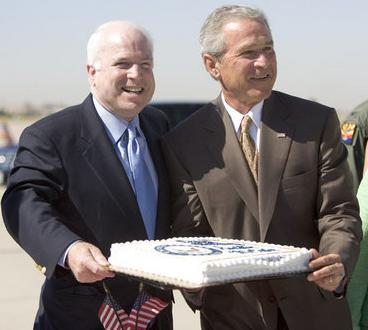
Another lock-step. Like all that information that had been available to the Bush Administration prior to Katrina. You know, the day that George W. Bush and John McCain celebrated McCain's birthday on the tarmac in front of Air Force One?

That very same Air Force One that Bush then used shortly thereafter to fly over the devastation?

President Bush knew not to fly over this latest hundred-year flood -- (he landed this time) -- as billions of acres of Heartland crops, the loss of which is destined to add to the world food crisis amid growing inflation, wash away along with people's homes and lives and dreams.

John McCain had not yet made his obligatory visit, though he does say he's coming. But not on the day Barack Obama was filling sandbags.
McCain was too busy giving his milquetoast grin with those insecure eyes that speak to his lack of surety at the podium, while he offered the oil industry even more obscene profits than they've been able to speculate through the Enron loophole that his own campaign adviser, Phil Gramm, put through to accommodate Gramm's wife's position on the Enron board (before Gramm went off to lobby for a Swiss bank with energy investments)...

[1] [2]

FEATURE

In Defense of Marriage


AnswerTips-Enabled


Last week someone asked me as a long married man what I thought of gay marriage. I said I was all for it; it was straight marriage I sometimes have my doubts about. I was joking, but like most jokes there was a kernel of truth in it. With the rate of divorce in this country at a record high level I wonder how the right wing keeps their self-righteous rhetoric going on the sacredness of traditional marriage, and why it feels so threatened by gay people who want the ceremony, the respect, and the legal rights of marriage. The denial of those rights seems outrageous in any country that considers itself a civil society. And there is the embarrassing fact that Republican John McCain, Libertarian Bob Barr, and half the Republicans and Democrats in Congress are divorced or serial adulterers, not counting those defenders of marriage who are lusting after Senate pages, and engaging in toilet booth toe tickles. Yes, I do believe in defending marriage but not by setting up walls of discriminatory law to prevent others from enjoying its privileges, its joys, and its struggles.

A few years back when many people mocked or condemned Hillary Clinton for staying married to Bill after the Monica mess, I thought it was among her bravest decisions. She would not let scandal or humiliation, a relentlessly prurient press, or a husband who was half a genius and half a jerk force her to end a marriage that for all its flaws meant a great deal to her and to her daughter. There was a better history to that marriage that she was not going to toss out to satisfy her critics during the impeachment. Marriage can be a litmus test for how a person might govern. Bill’s screw up within his marriage was not totally disconnected to some of his bad Presidential decisions, including his pardon of Mark Rich, and his embrace of NAFTA; suggesting immediate gratification without a thought of the consequences to his own reputation or to the nation’s workers.

I might even draw some political conclusions from the easy yet spirited and loving marriage of Michelle and Barak Obama, suggesting that he would be a leader who would respond to the country’s needs in a thoughtful and caring way:


Then look at the Bush marriage. Laura and George existing in separate worlds even as they inhabit the same space; the sad disconnect of a cheerful looking couple who have only one thing in common, an inability to face the facts: George, in his constant losing battle with reality, Laura smiling her ladylike library smile from one denial to another denial about the toxic consequences of her husband’s presidency. I might even contrast Obama with John McCain, whose marital history shows a streak of cruel opportunism, suggesting a man who will always abandon his principles and the welfare of the disadvantaged, as he abandoned his first disadvantaged wife when it proved expedient.

Having said that I have t
o step back a little for nobody, and that includes this writer, has the right to pass too harsh a judgment on other people’s loves and marriages, which doesn’t mean that I don’t do so from time to time. What I do know is that marriage is occasionally an arrangement, sometimes a marvel, often a mess, and always a mystery. I have observed that love ties us up in its amazing contradictions and confusions, and never more so than in a marriage.

Bush Speech Shakes Up Paris Climate Talks


AnswerTips-Enabled


At the U.S. sponsored climate meeting in Paris this week (third in a series), everyone was abuzz with the news that President Bush had chosen to offer his approach to greenhouse gases as the Paris talks opened:

The Bush speech was aimed largely at a domestic audience. Bush's aides said it was aimed at heading off a "train wreck" of varying legislation in the U.S. Congress.

Timed for Paris but not about Paris, a meeting that is the result of the U.S. inability to sort climate change at the
Bali meeting in December, which led to the follow-up meetings taking place parallel to the UN meetings on the replacement for the Kyoto Accord.

Confused yet?

Confusing and frustrating because not enough is being done and now President Bush, in his Rose Garden declaration, insists he has a better idea of how to lower greenhouse gases before it's too late, when the consensus is that the policies he's proposed are too little too late:
The meetings are part of a U.S.-sponsored series of negotiations on global warming. They involve representatives from the countries that produce 80 percent of the world's greenhouse gas emissions, blamed for heating the planet — including the United States, the 27-nation European Union, China and India.

Schalkwyk said Bush's speech "takes us backward," because it did not call for mandatory emissions cuts. Such cuts are central to U.N. negotiations on a follow-up plan to the Kyoto Protocol. Delegates from the European Commission and the EU presidency found Bush's strategy "disappointing," said the chief U.N. climate change official, Yvo de Boer.
Two weeks ago, I flew to London and then on to Scotland to find it covered in snow -- all of the UK. Which, of course, has been fodder for deniers who don't understand that climate change means climate instability and the cooler La Nina year we're experiencing will not necessarily be kind enough to repeat itself in 2009...

FEATURE

History Lessons


AnswerTips-Enabled

Cross-posted on The Huffington Post

In her recent speech at the Conference on World Affairs, Rachel Maddow cited James Madison's warning about the unitary executive, the propensity of an unchecked executive branch to lean toward war, whereas the legislature would be more likely to debate the issue before moving toward conflict.

Maddow's supposition, that the Bush administration's seeming incompetence, its torture memos, its rush to war, was by design -- Bush and Cheney's direct effort to shift power to the executive and, thereby, to shift the entire country to a more warlike stance -- does have historical precedence.

I'm not referring to Madison, though he did warn of this, or Jefferson, who raised prescient concern about undue influence, but earlier in history to the systems that Madison and Jefferson used as the inspiration for their grand experiment: The Roman Republic of Caesar's time and the Greek democracy of Solon.

This is not to say that George W. Bush is Julius Caesar or that any of his lawgivers (like the ones who approved that torture memo) are Solon. But there are interesting parallels to the way that Caesar and his contemporaries used war to further their wealth and political ambitions, as well as to the actions that Solon's contemporaries took to undermine codified law.

Need a better seat in the Roman Senate? Get yourself posted to Hispania (Spain). Need funds to run a campaign for consul (president) or junior consol (vice-president)? Go to war with Gaul (France).

Need to prove yourself in an ill-timed, ill-thought out adventure in Parthia (Syria, Iraq, Iran)? Be like Crassus and attack preemptively and get your army decimated in the process.

For Solon, the author of democracy? Have a law that your opponents don't like? Make it good for ten years after you leave office. Solon did that with laws we'd likely support (limiting unfair financial practices toward the poor...). Bush? Tax cuts for the rich. Which would have been fine with the corporate interests in Greece (known as oligarchs - that's where the word comes from), who made sure Solon's attempts at fairness wouldn't last by overthrowing his protégé, Pisistratus, leading to periods of instability broken only by the need for the people came together to fight a common enemy (interchangeable between Persia, the Peloponnesians, Philip of Macedonia...).

Alexander and his successors put a stop to that (for a while), after which, Rome reduced Greece to a province in their march to rule the world. But the struggles between the wide ideals of democracy and the narrow interests of oligarchy have never gone away. Indeed, it should be familiar to those who look askance at the hundreds of millions of dollars required to run a presidential campaign and are now (finally) questioning how the common interests of the people could have any meaning in such an environment...

FEATURE

President Bush Intervenes on EPA Smog Ruling


AnswerTips-Enabled


Cross-posted on Reuters

George W. Bush personally intervened on the new EPA smog ruling by pushing them to lower the standards more than the EPA wanted, to standards already lower than the recommended limit:
WASHINGTON - The U.S. Environmental Protection Agency agreed to weaken an important part of its new smog requirements after being told at the last minute that President Bush preferred a less stringent approach, according to government documents. They show tense exchanges between the EPA and the White House Office of Management and Budget in the days before the smog air quality standard was announced Wednesday. ~snip~

The disagreement concerned the amount of protection from ozone, or smog, that should be afforded wildlife, farmlands, parks and open spaces.
This "public welfare" or "secondary" smog standard is separate from a decision to tighten the smog requirements for human health, which the EPA decided to do by reducing the allowable concentrations of ozone in the air from 80 parts per billion to 75 parts per billion.


The lowering of ozone to 75 parts per billion is far less than recommended by scientists, environmentalists and other experts for immediate human health. The 'secondary' smog standard is there to protect the environment over the
long term...


FEATURE

Auto fuel efficiency bill signed into law


AnswerTips-Enabled

A bill raising auto fuel standards for the first time in over thirty years was signed by President Bush today, requiring that automobiles average 35 miles per gallon by 2020 and raising federal support for alternative fuel and conservation programs.

It passed by a wide margin in the House, but was stalled momentarily in the Senate when Republicans filibustered out a provision that would have eliminated tax breaks for oil companies and required utility companies to provide a portion of their power from alternative sources.

After which, the head of the Sierra Club referred to the bill as a partial victory and vowed to put through the redacted provisions at a later date.

One area of the bill that has been praised is the instruction to use non-food sources for biofuels (i.e. switch grass and wood chips instead of corn). The other is the raising of the fuel standard itself, which should help to reduce the amount of greenhouse gases currently emitted.

More information here.

FEATURE

Bali Climate Change Talks at Risk: Compromise Negotiations Underway


AnswerTips-Enabled


The same day that the University of East Anglia
reports that 2007, despite the cooling effects of La Nina, has been the seventh warmest year on record, word came from the U.N. Climate Conference in Bali that the talks were in danger of breaking down:
European leaders and environmental campaigners reacted angrily yesterday after the United States rejected guidelines for reducing greenhouse gas emissions intended to check global warming.

The proposal, supported by the members of the European Union as well as Brazil, would have set out in writing an ambition to cut greenhouse gases produced by industrialised countries by up to two fifths in the next 13 years.

-snip-

The row has undermined the hopes of environmentalists for a strong and detailed statement of agreement among the 190 governments attending the United Nations climate change conference on the Indonesian island of Bali. Link.
This has lead to a proposal for a compromise deal. If they cannot come to agreement, participants have threatened to to bypass next month's Bush Administration's climate meetings set for Hawaii.

Al Gore, speaking before the gathered representatives, acknowledged this:

"My own country, the United States, is principally responsible for obstructing progress here in Bali. We all know that. But my country is not the only one that can take steps to insure that we move forward from Bali with progress and with hope. "

From Jennifer Morgan of the Climate Action Network (who did not mince words): "There is a wrecking crew here in Bali, led by the Bush Administration and its minions. Those minions continue to be the governments of Canada, Japan, Saudi Arabia and others..."


And from Yvo De Boer, UN Climate Chief: "I'm very concerned about the pace of things. If we don't manage to get the work done in time on the future, then the whole house of cards basically falls to pieces."

The battle is about the EU's request for a non-binding agreement on carbon emissions. You read that correctly. The "wrecking crew" is balking at a non-binding agreement. There is concern that, if this cannot be resolved, the statement that comes out of Bali will be so anemic as to be useless in furthering the implementation of climate goals in the years ahead.

The U.S. representative, Under Secretary of State, Paula Dobriansky, dismissed that, saying that "we don't have to resolve all of these issues here in Bali." She called instead for a "solid Bali road map, one that sets the stage for robust, constructive and ground-breaking negotiations in the months ahead."

The EU and other member nations disagree, as does the U.N., which put out this robust and constructive road map in February of 2007.

The negotiations for the compromise deal has extended the conference:
The EU has been pressing for the final text to include a specific commitment that industrialised nations should cut their emissions by 25-40% by 2020.

The US and Canada oppose firm cuts - a draft text circulating around contains no figures for 2020.

The Indonesian hosts have been trying to bridge the gulf between the sides. Link.

The Director of Friends of the Earth reports that the pressure on the U.S. from the EU is "immense" right now to agree to the EU 25-40% emission reductions proposed for 2050. It is not known whether the Bush Administration will agree or if the target number will be left out. Friends of the Earth reports that it is not the American people or American business that disagrees, but only the Bush Administration that is standing in the way of the deal.

The conference is set to conclude today.


FEATURE

NASA's Climate Change Satellites - Drastic White House Cuts Leaked


AnswerTips-Enabled

Cross-posted on Huffington Post

Just after George Bush announced his
plans to address climate change, both NOAA and NASA experts revealed that the Bush Administration is "drastically scaling back efforts to measure global warming from space."

No word whether this issue will be raised at the climate change meeting Bush has called for September 27-28 (different from the UN meetings that will take place on September 24th to “promote discussion on possible ways to move the international community toward negotiations on new global agreement on climate change"), but it seems like it should be:
Bush Climate Meeting Draws Doubts about Action – August 08, 2007 – By Deborah Zabarenko (Reuters) -- A U.S. summit in September on climate change, one of at least four international meetings set for this year, is already raising doubts about any action being taken before President Bush leaves office.Link.

So, what happened to the Climate Change Satellites?

A confidential report to the White House, obtained by The Associated Press, warns that U.S. scientists will soon lose much of their ability to monitor warming from space using a costly and problem-plagued satellite initiative begun more than a decade ago. Because of technology glitches and a near-doubling in the original $6.5 billion cost, the Defense Department has decided to downsize and launch four satellites paired into two orbits, instead of six satellites and three orbits. Link

According to the American Association for the Advancement of Science, which calls it a crisis, Atmospheric scientist Timothy L. Killeen, the president of the American Geophysical Union, says it [the loss of the satellites] "could harm our ability to protect our citizens." and "Unfortunately, the recent loss of climate sensors ... places the overall climate program in serious jeopardy," NOAA and NASA scientists told the White House in the Dec. 11 report obtained by the AP.

December 11th, 2006...

So, this means that George W. knew about this CONFIDENTIAL report that we weren't supposed to know about (which has now been leaked to the AP) before he announced his climate change initiative for September. But, it's not only the Bush Administration that needs to be taken to task for this debacle. According to the report, the White House requested $331 million for their scaled back version of the satellite system in their 2008 budget.

The AAAS [The American Association for the Advancement of Science] issued a Board Statement on April 27, 2007, regarding this pending Climate Satellite crisis asking for Congress to address the issue:

The network of satellites upon which the United States and the world have relied for indispensable observations of Earth from space is in jeopardy. These observations are essential for weather forecasting, hurricane warning, management of agriculture and forestry, documenting and anticipating the impacts of global climate change, and much more. Maintenance of an adequate constellation of Earth-observing satellites and the instruments they carry is now threatened by budget cuts and reallocations in the two federal agencies that share the primary responsibility for them, the National Aeronautics and Space Administration (NASA) and the National Oceanic and Atmospheric Administration (NOAA). The situation is already causing harm, and it will become rapidly worse unless the Congress and the Administration take prompt action to reverse the recent trends. Link

A major study has just been completed by the National Research Council, entitled Earth Science and Applications from Space: A Community Assessment and Strategy for the Future: The Space Studies Board, in consultation with other units of the NRC, will lead a study to generate consensus recommendations from the Earth and environmental science and applications community regarding a systems approach to space-based and ancillary observations that encompasses the research programs of NASA and the related operational programs of NOAA.

The NRC study offered detailed recommendations for restoring U.S. capabilities in Earth observations from space to acceptable levels, including:

  • Reconstituting specific key observation capabilities that have recently been deleted from scheduled NOAA satellite series
  • Accelerating NASA’s current launch schedule to shrink the data gaps implied by current plans
  • Committing to the 17 highest-priority new Earth-observation missions, out of more than 100 candidates evaluated for the 2010-2020 time period.

The study concluded that its recommendations could be funded until 2020 by returning the Earth-science budget at NASA to its FY 1998-2000 level and stabilizing the budget of NOAA’s National Environmental Satellite Data, and Information Service at only slightly above the FY2007 level, adjusted for inflation.

Jerry Mahlman, a former scientist at NOAA who is now at the National Center for Atmospheric Research, said he and other colleagues warned of problems as far back as 1995. He compared the preparations for the satellites to a "planned train wreck."

The planned satellites Jerry Mahlman is referring to? The National Polar-orbiting Operational Environmental Satellite System, or NPOESS, which was first announced in 1994. This system was to combine the Defense Department's weather forecasting with NOAA's climate data gathering. There was also a provision for involving Europe and Japan's Meteorological Satellites. In 2005, however, the GAO found cost overruns to the tune of 9.7 billion (with a B) in an effort that was over a year behind schedule. The Pentagon weighed in last year, citing the program at 11.5 billion and even further behind schedule.

The White House's answer? Science Advisor Marburger: "We’re obviously very concerned about this," he told the AP. "It got in trouble and we couldn’t fit all those instruments on it ..."

The Pentagon, the National Oceanic and Atmospheric Administration and NASA have announced they will have to rely on European satellites for most of the climate data until they figure this out.

Until they do, all I can say is someones's doing a heckofajob...

FEATURE

Frontline's Exposé of Iraq War Endgame Strategy


AnswerTips-Enabled

Frontline's latest documentary, ENDGAME (what when wrong, and why, in America's tragically failed effort to find a strategy for success in Iraq), shows a shocking level of incompetence leading to the options we face now:

On Dec. 19, 2006, President George W. Bush said for the first time that the United States is not winning the war in Iraq. It was a dramatic admission from a president who had insisted since the start of the war that things were under control.

Now, as the U.S. begins what the administration hopes is the final effort to secure victory through a "surge" of troops, [snip] military and government officials talk to FRONTLINE about both the military and political events that have led up to the current "surge" strategy.

http://www.pbs.org/wgbh/pages/frontline/endgame/

The fifth in a series on the Iraq war, this documentary casts a clear light on the mistakes made at the highest levels, both from a civilian and military point of view.

In a particularly telling segment, Thomas Ricks from the Washington Post refers to the army's early strategy as: "War Tourism."

"You have war tourism. Units based on big forward operating bases - FOBS, going out and doing patrols from Humvees, usually not foot patrols, but mounted patrols, and then coming back to their base. If that's the way you're operating, you're not in the war. You're simply a war tourist."

General Jack Keane (Ret.), former Army Vice Chief of Staff, added:

"When you look back on that, and analyze that, it's a short war strategy. Nowhere in there, is a plan to defeat the insurgency."

The documentary points out that the original strategy was to leave Iraq by Sept. '03, that the top generals in charge were brought back shortly after the invasion and command was assigned the "lowest ranked three start general in the Pentagon" (Sanchez) for what what was, essentially, supposed to be a mopping up and withdrawal operation.

The narrator says the planning did not account for an insurgency.

One can't help but remember Saddam Hussein saying -- prior to the start of the war -- if you attack we'll turn Iraq into another Vietnam.

In fairness to Gen. Casey (the four star general brought in to replace Sanchez after Abu Ghraib), he was one of the first to point out that the solution needed to be political, not military, after he realized his requests for more troops would not be met.

He brought in a large group of military strategists (Casey's Ph.D's) who tried to figure out the best way fight the insurgency without alienating moderate Sunnis. At one point, they suggested the military hold off on attacking the insurgents at Fallujah until they could figure out a way to reach out to the moderate Sunnis.

That strategy lasted until Nov. 8, 2004 (just after the Iraqi election). Then the army was sent in to take Fallujah.

"Ultimately," according to Major Thomas Mowle, one of the advisers that Casey had assembled, "if you draw out all the events that followed Fallujah, that certainly decreased the Sunni Arab support and, in that sense, it did help the insurgency."

The Iraqi elections produced warnings from Casey's Ph.D's that the Sunni boycott had split the Iraqi government into something that would increase the insurgency and prevent a political solution at the same time that Bush's rhetoric was painting the result at Fallujah as a success.

It's important to note that it was not that the military on the ground that failed. Specifically, the successful strategy created by a Col. H.R. McMaster (Clear, Hold and Build), where his troops went into a city, lived among the population in small units, built trust and protected the population while they fought the insurgents.

Requests to implement his strategy that went up the ranks were stopped at the highest levels. The reasons given: it would take more troops and put them in more danger. Thomas Rick's reaction: you can't fight a war as a tourist." It was not implemented by the Pentagon.

The State Department representative in Iraq heard about "Clear, Hold and Build" and flew back to tell Condoleeza Rice. Rice then went before Congress and, in what turned out to be a direct challenge to Rumsfeld, formally recommended the Clear, Hold and Build strategy during a hearing that was broadcast live.

Rumsfeld quickly held a press conference where he said (paraphrase): we didn't have the troops to implement it and it wasn't our responsibility to protect the Iraqis.

The insurgency exploded.

The State Dept and several generals did not give up on the idea of Clear, Hold and Build, however. While acknowledging it would put more troops at risk, they pointed to Col. McMasters' success as the only feasible strategy, and also noted, in what was described as an act of sheer will on McMasters' part, that he managed to do it with the limited number of troops he'd been given.

Limited was the condition during the summer of '06 when Clear, Hold and build was tried on a "limited" basis -- enough resources to clear but not to hold, with Iraqi troops for the hold part.

Which Gen. Keane says was doomed to failure.

Which it did (just before the '06 elections).

Rumsfield's departure soon followed. After that, the drive for the strategy of Clear, Hold and Build began to gain momentum, renamed "Surge", which Keane was told to put together for a presidential briefing. He says he was clear with President Bush about the resources needed, the risks, the need for a political solution, etc.

Keane came away from the meeting thinking he had a consensus.

But Thomas Ricks, referring to Dick Cheney as the "Moby Dick" of the administration, said that Vice President "Cheney, as a rule, goes in after meetings and works on Bush until he changes the outcome of decisions."

As a result, the Clear, Hold and Build, which had worked with McMasters, began with exponentially less troops than were needed to provide success.

Gates and Petraeus then came on board. General Petraeus, who Ricks describes as a realist, a strong advocate of Clear, Hold and Build, brought both Keane and McMasters into his inner circle once he took command and ordered the implementation of the "Surge" years after McMasters had proven its feasibility.

Some conclusions after viewing the documentary:

  1. The planning from the start was to go in and get out within a few months. Anything that didn't fit in with that strategy was disregarded.

  2. The bases and embassy planned were part of a combination army and contractor force that would stay to protect oil resources and as a forward operating base on both Syria and Iran's borders, while the combat invasion forces would be withdrawn.

  3. The experienced commanding generals were called back within a few months of the invasion and the command.

  4. The successful strategy developed early on by Col. McMasters, Clear, Hold and Build, was not supported by Rumsfeld and, as such, was not implemented until the arrival of Gates and Petreus.

  5. Condolezza Rice did see the value in Clear, Hold and Build enough to challenge both Cheney and Rumsfeld by going before Congress to advocate for it.

  6. The Clear, Hold and Build strategy was refused by Rumsfeld at a time when the circumstances on the ground might have allowed that strategy to provide for a political solution.

  7. After Rumsfeld was ousted, Clear, Hold and Build was put into planning stages, resulting in what is described now as "The Surge."
LINKS:

FRONTLINE: ENDGAME on PBS.

And the five part FRONTLINE ENDGAME SERIES ON THE IRAQ WAR (Video)

FEATURE

UK Report urges distance from US


AnswerTips-Enabled

UK think-tank, Chatham House, has just released this report:

"which assessed British foreign policy since 1997, says Mr Blair's successor would also have to rethink Britain's role within the European Union and distance it from the US."

In a call for a rebalancing of UK foreign policy, the report determines that the "'disaster' of Iraq and Tony Blair's failure to influence US policy will overshadow his time as prime minister," and "The 2003 invasion and the post-war 'debacle' have damaged Britain's international influence."

Tony Blair’s successor(s) will not be able to offer unconditional support for US initiatives in foreign policy and a rebalancing of the UK’s foreign policy between the US and Europe will have to take place.

A "rebalancing of of the UK’s foreign policy between the US and Europe will have to take place."

Bush and Co. shifting the balance of power to the EU? Was that in the plan?

Was there a plan????

While the report goes on to offer some support for some of Blair's other positions (establishment of the International Criminal Court, global warming and Kyoto Accord, calling for an I/P two-state solution, military campaigns in Kosovo, Sierra Leone and Afghanistan, most of his work with Clinton), it paints Blair's ability to influence Bush as:

The post-9/11 decision to invade Iraq was a terrible mistake and the current débâcle will have policy repercussions for many years to come. The root failure of Tony Blair’s foreign policy has been its inability to influence the Bush administration in any significant way despite the sacrifice – military, political and financial – that the United Kingdom has made.

Which leads to the report's conclusion:

His successor(s) will not make the same mistake. For the foreseeable future, whoever is prime minister, there will no longer be unconditional support for US initiatives in foreign policy. Nor will it make much difference who is in power in the United States.

...a new US president, from either party, will certainly make things easier in view of the extraordinary public hostility that George Bush has
generated in Britain and elsewhere. However, like Suez 50 years ago, the Iraq débâcle marks a watershed in British foreign policy that will alter the relationship with the United States for many years to come.

Again, here's the link to the Chatham House report and the BBC story about same.

IN THIS ISSUE