Loading...
HOME
POLITICS
CLIMATE
BUSINESS
SCIENCE
WORLD
HISTORY
LIFESTYLE
EDITORIAL
RESOURCES
CONTACT
Showing posts with label Austin American-Statesman. Show all posts

FEATURE

Searching for Relevancy in an Obama World


AnswerTips-Enabled


I spoke with a friend the other day, one of those rare individuals who'd passed his 87th birthday with a clear perspective on life that went beyond even his years, and heard from him frustration that has been echoed both by others of his generation and by those who are not yet of age to drink or vote.

The question they've been asking is: what happened?

What happened to the values for which the WWII generation fought and died? What happened to our principals about saving money and living within our means? What happened to fighting for freedom of religion and thought and tolerance? What happened to personal responsibility and the willingness to sacrifice to meet a shared goal? What happened to the moral centers of those in charge for the last few decades that made them think they could use the earth as their personal or corporate garbage dump, their offshore bank account, their property to pillage?

My friend bemoaned the generation that had followed his as trust-fund babies given every opportunity after a hard-won victory, who did not understand or care about the sacrifices made to provide them with the right to become something more than their fathers.

Instead, he complained, they squandered it for short term gain and immediate gratification.

I have heard the same from those younger than me. How could so much have been lost so fast? What about us? What will happen to our lives and our children now that our fathers and mothers have spent their inheritence? Who broke America, who broke the world, who is going to fix it?

The answer most people in America give, according to the polls, is Barack Obama. There is a lot to be said for his accomplishments in so short a time -- increased national debt notwithstanding (given the enormity of the problems he has inherited) -- but that's not, I suspect, the answer he would give. The president would say (and has said) that we all have to change to get out of this mess. Continued...

FEATURE

Giant Antarctic Ice Shelf Collapses


AnswerTips-Enabled


The National Ice and Snow Institute (NISDC) has released a report documenting a dramatic and troubling collapse of a large portion (nine times the size of Manhattan) of the Wilkins Ice Shelf in Antarctica.

Satellite imagery from the National Snow and Ice Data Center at the University of Colorado at Boulder reveals that a 13,680 square kilometer (5,282 square mile) ice shelf has begun to collapse because of rapid climate change in a fast-warming region of Antarctica.

The Wilkins Ice Shelf it's a broad plate of permanent floating ice on the southwest Antarctic Peninsula, about 1,000 miles south of South America. In the past 50 years, the western Antarctic Peninsula has experienced the biggest temperature increase on Earth, rising by 0.5 degree Celsius (0.9 degree Fahrenheit) per decade. NSIDC Lead Scientist Ted Scambos, who first spotted the disintegration in March, said, "We believe the Wilkins has been in place for at least a few hundred years. But warm air and exposure to ocean waves are causing a break-up."

The ice shelf began its visible collapse on February 28th, when a huge iceberg (41 x 2.5 kilometers - 25.5 by 1.5 miles) broke away, triggering a wider collapse of 405 square kilometers (160 square miles) of the shelf.


The edge of the shelf crumbled into the sky-blue pattern of exposed deep glacial ice that has become characteristic of climate-induced ice shelf break-ups such as the Larsen B in 2002. A narrow beam of intact ice, just 6 kilometers wide (3.7 miles) was protecting the remaining shelf from further breakup as of March 23.

"The Wilkins disintegration won't raise sea level because it already floats in the ocean, and few glaciers flow into it." Scambos said. "However, the collapse underscores that the Wilkins region has experienced an intense melt season. Regional sea ice has all but vanished, leaving the ice shelf exposed to the action of waves."
Scientists have tracked this event with great interest, both for the indications of warming, the loss of habitat and the concern that other ice shelves, similarly impacted, do have the potential to significantly raise sea level. NASA's Moderate Resolution Imaging Spectroradiometer (MODIS) and data from ICESat alerted scientists to the ice shelf's collapse in mid-March...

Photo Credit (1): National Snow and Ice Data Center; Photo Credit(2): National Snow and Ice Data Center/NASA

FEATURE

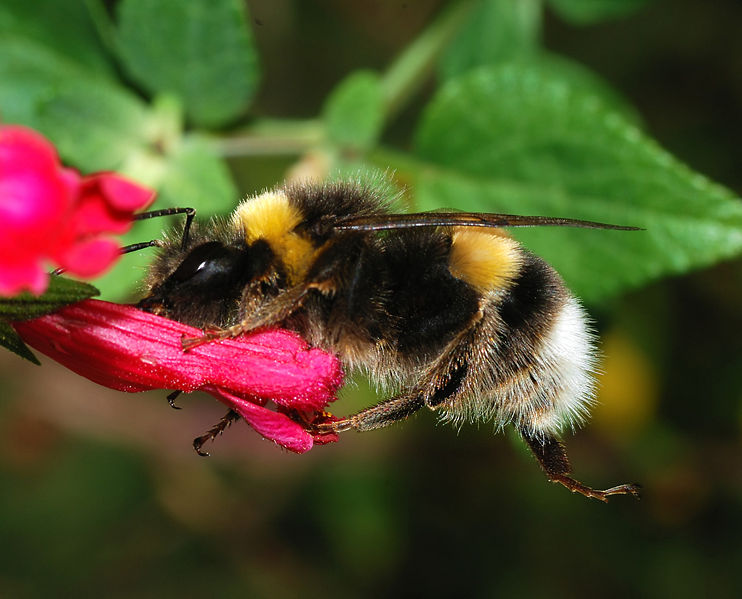
The Plight of the Bumblebee


AnswerTips-Enabled


Cross-posted on Huffington Post, Earth911, Atlanta-Journal-Constitution,
Austin American-Statesman, Palm Beach Post, Longview News-Journal


With all the focus on the disappearance of the honeybee, there has been little discussion about the plight of the bumblebee, one of the hardest workers in the wild world of agriculture, despite this warning issued by the National Academy of Sciences October 2006.

That focus may now change as word comes from scientists that at least one bumblebee species from the Northwestern region of the United States, Franklin's Bumblebee,
may have gone extinct.

This is a serious development. Not only because the loss of any species due to human activity is, in this writer's opinion, unconscionable, but because we depend on this species more than we've taken the time to understand.

According to this newly released National Academy of Sciences report, the bumblebee is one of many pollinators losing their battle to survive because of 'habitat lost to housing developments and intensive agriculture, pesticides, pollution and diseases spilling out of greenhouses using commercial bumblebee hives.'

Long-term trends for several wild bee species -- especially bumblebees -- as well as some butterflies, bats, and hummingbirds also show population drops, the committee found. -snip-

Like the honeybee, the bumblebee has been hurt by the introduction of a non-native parasite. Many pollinator declines are associated with habitat loss...

It turns out that our native American bumblebee (the honeybee was imported) does more than provide a pleasant bass note to the summer hum we hear outside our window...


IN THIS ISSUE